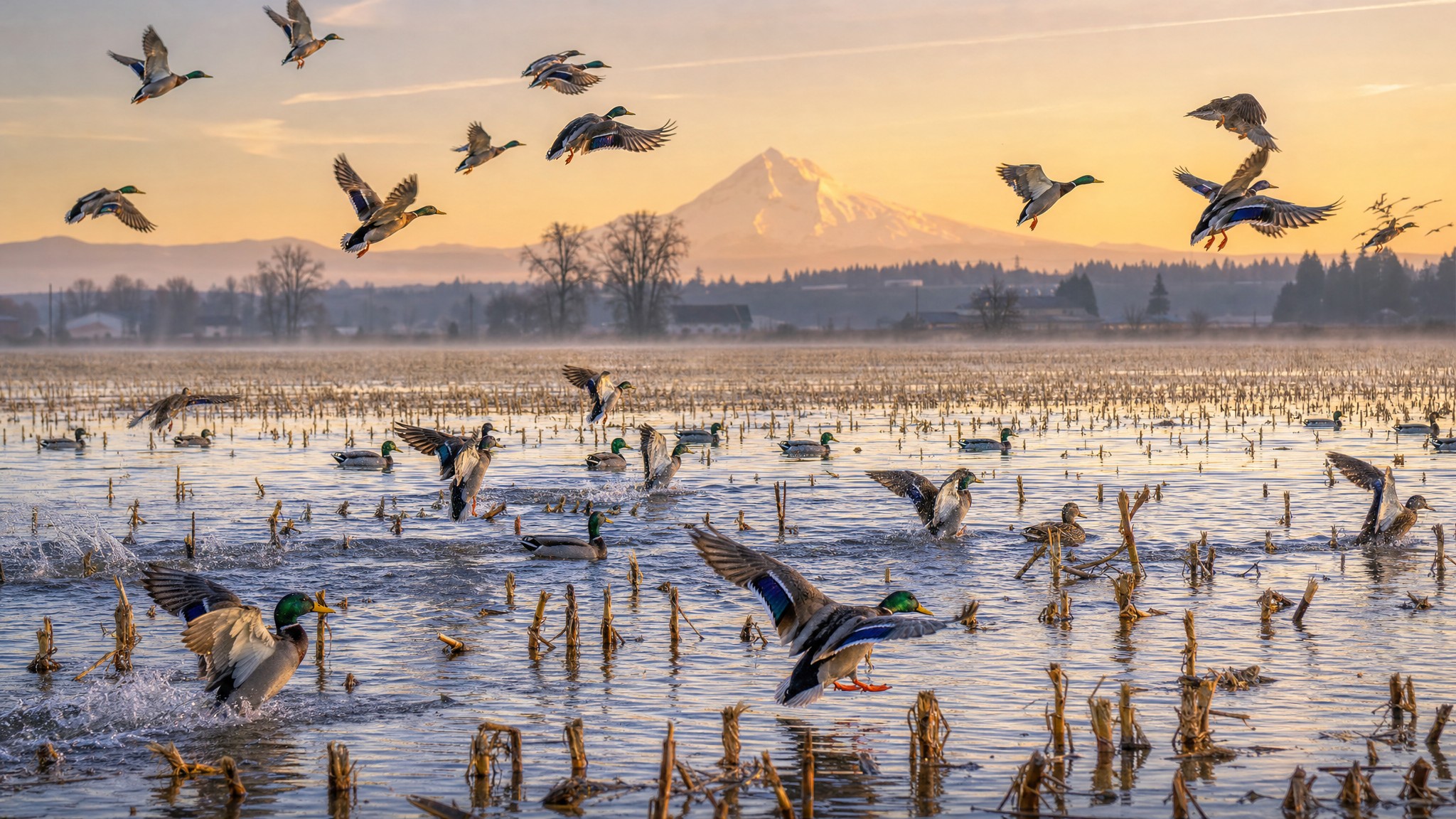
There's a week or two every November when Oregon mallard hunting reaches its peak — when the first serious cold front sweeps down from British Columbia and pushes a fresh wave of ducks into the Willamette Valley, the flooded fields around Linn and Benton counties are holding birds that haven't been pressured since they crossed the border, and the sloughs along the lower Willamette and its tributaries are stacked with greenheads looking for somewhere quiet to loaf. That window doesn't last long. Here's how to make the most of it.
Understanding Oregon's November Mallard Migration
Oregon sits on the Pacific Flyway, and the Willamette Valley is one of its most productive staging areas. Mallards from breeding grounds in British Columbia, Alberta, and the northern Great Plains begin moving into western Oregon in October, but the real push happens in November when the first sustained freeze locks up the shallow wetlands farther north. Watch the weather maps. A strong arctic high pressure system pushing into Alberta and eastern Washington is your signal — birds will be moving within 24–48 hours.
The Willamette Valley's combination of flooded grass seed fields, fallow agricultural ground, and permanent slough habitat makes it a mallard magnet. By mid-November, resident birds that have been feeding in the valley all fall are joined by migrants that have dropped out of the sky tired and looking for food. These newly arrived ducks are your best opportunity — they haven't been educated by weeks of hunting pressure and will work a decoy spread honestly.
Key Areas: Willamette Valley Mallard Hotspots
Finley National Wildlife Refuge (Benton County)
The William L. Finley NWR south of Corvallis holds excellent mallard numbers in November. The refuge has limited hunting access through a quota system — apply early through ODFW's reservation system. The wetland complexes here attract birds from miles around, and hunting the refuge boundary areas on the adjacent private ground (with landowner permission) can be very productive as birds trade between the refuge sanctuary and surrounding agricultural fields.
Ankeny NWR and Baskett Slough
The chain of Willamette Valley refuges — Ankeny near Jefferson and Baskett Slough near Dallas — creates a concentration effect that benefits hunters on adjacent private property. Birds using these refuges to rest move out to feed morning and evening. Scout from public roads to identify flight lines and feeding fields within range. Field permission is the key to this hunting.
Tualatin River and Wapato Lake Area
The Tualatin Valley in Washington County holds some of the best public mallard hunting in the northern Willamette Valley. The Tualatin River NWR near Sherwood has limited walk-in access. Wapato Lake NWR near Gaston offers flooded marsh hunting that rivals any public ground in Oregon when birds are in the system.
Lower Willamette Sloughs (Multnomah County)
The backwater sloughs and Columbia River bottomlands around the Portland metro area hold mallards throughout November. Locally known spots like Sturgeon Lake on Sauvie Island (covered separately) are well-known, but the smaller backwater channels between Sauvie Island and St. Helens see less pressure and can be outstanding for a small group of hunters running a canoe or jon boat.
Flooded Field Permission Hunting
The highest-percentage November mallard hunting in the Willamette Valley is on private flooded grass seed fields in Linn, Benton, and Lane counties. These fields — ryegrass and fescue stubble that's been flooded by winter rains or intentional irrigation — are the preferred feeding habitat for Willamette Valley mallards. The birds work them like clockwork: out of roost wetlands before first light, into the fields to feed for 2–3 hours, back to water to loaf midday, and potentially a second feed in the afternoon.
Getting permission requires knocking on doors before the season opens. Many landowners are receptive if you're polite, offer to manage access, and commit to following their rules. Leave contact information and check in every time you hunt. The relationships you build can last decades.
Decoy Spreads for November Willamette Valley Mallards
November mallards in flooded fields want to see big spreads with realistic movement. Here's what works:
- Quantity: 2–4 dozen decoys minimum for field hunting. Birds dropping out of migration have seen a lot of water and are looking for company. A lonely dozen decoys in a 40-acre field looks wrong.
- Motion: A spinning-wing decoy (Mojo or equivalent) is legal on Oregon's Pacific Flyway during the regular duck season and is highly effective early in the season on fresh birds. Some experienced hunters pull them midseason when local birds get wise to them.
- Realism: Mix full-body field mallard decoys with floaters if you're working a field with standing water. Greenhead-to-hen ratio of about 1:3 mimics natural flocks.
- Placement: Leave a landing zone into the wind, 20–25 yards in front of your blind. Birds want to land short of the main group and walk in — give them that comfortable gap.
Calling Strategy
Oregon mallard hunting rewards callers who know when to stop. Fresh migrant birds often need little more than a greeting call and a feeding chuckle to commit. Over-calling is the most common mistake. The sequence that works: loud greeting hail call when you spot birds at distance, hen feeding chatter as they circle and begin to commit, silence on the final approach as they're locking up. If birds flare at 60 yards, you called too much at the wrong moment. Let the decoys do the work inside 100 yards.
Guns and Loads
Oregon waterfowl hunters must use non-toxic shot. For November mallards at typical field ranges of 20–45 yards:
- Steel #2 or #3 shot at 1,400–1,550 fps is the workhorse load. Federal Speed-Shok, Winchester Xpert, and Fiocchi all make quality affordable steel loads in this range.
- Bismuth or Heavyweight TSS for tight-choke work or shots pushing past 45 yards where steel penetration becomes marginal.
- Choke: Modified or Improved Cylinder for steel shot (never use full choke with steel — it will damage your barrel). Many hunters run a Patternmaster or similar ported waterfowl choke for best patterns with steel.
- Gun: A 12-gauge 3-inch chamber covers every situation. Semi-autos cycle steel more reliably than older pump guns with tight chambers — if you're running vintage steel, check the tolerances.
Regulations Checklist
- Valid Oregon Angling/Hunting License + Pacific Flyway Duck Stamp (federal) + Oregon Upland Validation (not required for ducks, but confirm current regs)
- HIP (Harvest Information Program) registration — required for all migratory bird hunters, free at any license vendor
- Non-toxic shot only — lead shot is prohibited for waterfowl
- Check ODFW's current season dates and bag limits — Willamette Valley zone dates may differ from Columbia Basin
- Shooting hours: 30 minutes before sunrise to sunset
Final Thoughts
Peak Oregon mallard hunting in November is one of those experiences that reminds you why you got into waterfowling in the first place. The sound of wings in the dark, the first gray light revealing a sky full of circling birds, the moment they commit and drop their feet — it's hard to replicate. Put in the scouting time, secure your access, run a solid spread, and call with restraint. November won't last forever, but the memories will.