The 6.5 Creedmoor has become the dominant long-range hunting and competition cartridge of the last decade, and for good reason — it's efficient, accurate, and mild on barrel wear relative to its performance. But its success on the range and in the field depends heavily on powder selection. The 6.5 Creedmoor's relatively small case with a long projectile column leaves less room for error than a .308 or .30-06, so powder choice has a significant effect on velocity, accuracy, and pressure safety.
What Makes a Good 6.5 Creedmoor Powder
The 6.5 Creedmoor performs best with medium to medium-slow burning powders — roughly in the burn rate range of IMR 4350 to RL-26. The case volume and 24" barrel (typical for precision rifles) favor powders that keep burning through the barrel length, maximizing case fill and efficiency. A powder that's too fast gives high pressure without velocity; one that's too slow doesn't fully combust in shorter barrels.
Temperature stability is increasingly important for field use. A load that shoots 2,700 fps on a 70°F bench day should perform predictably at 25°F on a cold November morning in Eastern Oregon. Temperature-insensitive (TI) powders have become increasingly popular for exactly this reason.
Top Powder Choices
Hodgdon H4350 (and CFE 223)
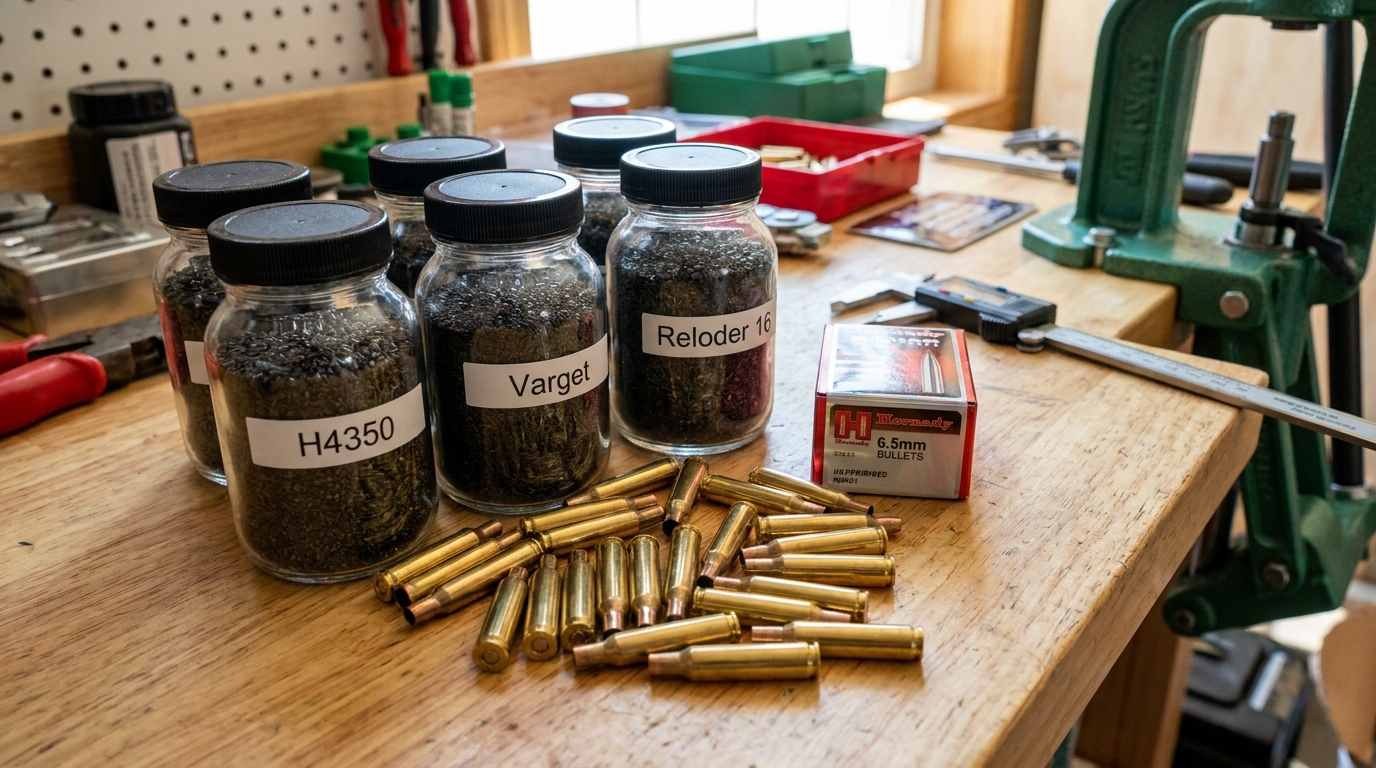
H4350 has been the benchmark powder for 6.5 Creedmoor since the cartridge was introduced. With 140-grain bullets (the most common weight for both competition and hunting), H4350 consistently delivers sub-MOA performance, fills the case efficiently (around 93–96% case fill), and is available in most areas. The Extreme Extruded series of Hodgdon powders has good temperature stability. Starting load is approximately 38.5 grains, max around 41.5 grains with 140gr bullets — always consult your manual.
Reloder 16 (Alliant)
RL-16 has gained a strong following among precision shooters who want both excellent velocity and outstanding temperature insensitivity. It's slightly slower than H4350 and performs best in 24"+ barrels. Competition shooters in particular favor RL-16 because the ES (extreme spread) between shots is very tight, and velocity stays consistent from summer to winter. Hard to find during powder shortages but worth stocking when available.
IMR 4451 / IMR 4350
The IMR powders deliver classic performance in 6.5 Creedmoor. IMR 4451 (Enduron series with excellent TI characteristics) performs very similarly to H4350 and offers a good alternative when Hodgdon products are unavailable. IMR 4350 runs slightly faster but still produces excellent accuracy with 120–130 grain bullets.
Varget (for lighter bullets)
For 120-grain and lighter bullets, Varget is an excellent choice. It's a bit fast for 140s but ideal with hunting bullets in the 120–130 grain range. Varget's temperature stability and availability make it a field-practical choice for hunters who load lighter, faster bullets for deer and pronghorn at moderate ranges.
Practical Load Development
Start 5–10% below maximum published loads and work up in 0.5 grain increments, looking for the accuracy node — the powder charge where three or five-shot groups tighten before widening again as pressure increases. Measure velocity with a chronograph to verify you're in the expected range. A 140-grain bullet from a 24" barrel should be in the 2,650–2,750 fps range with most suitable powders.
Once you find your accuracy node, verify the load performs consistently across temperature extremes before relying on it for hunting or competition. That 2,700 fps load shouldn't drop more than 25–30 fps in cold weather with a good TI powder.
The 6.5 Creedmoor rewards handloading more than most cartridges — the combination of a quality powder, a match-grade bullet, and careful technique will consistently outperform factory ammunition in your rifle. It's worth the investment in components and time to get it right.