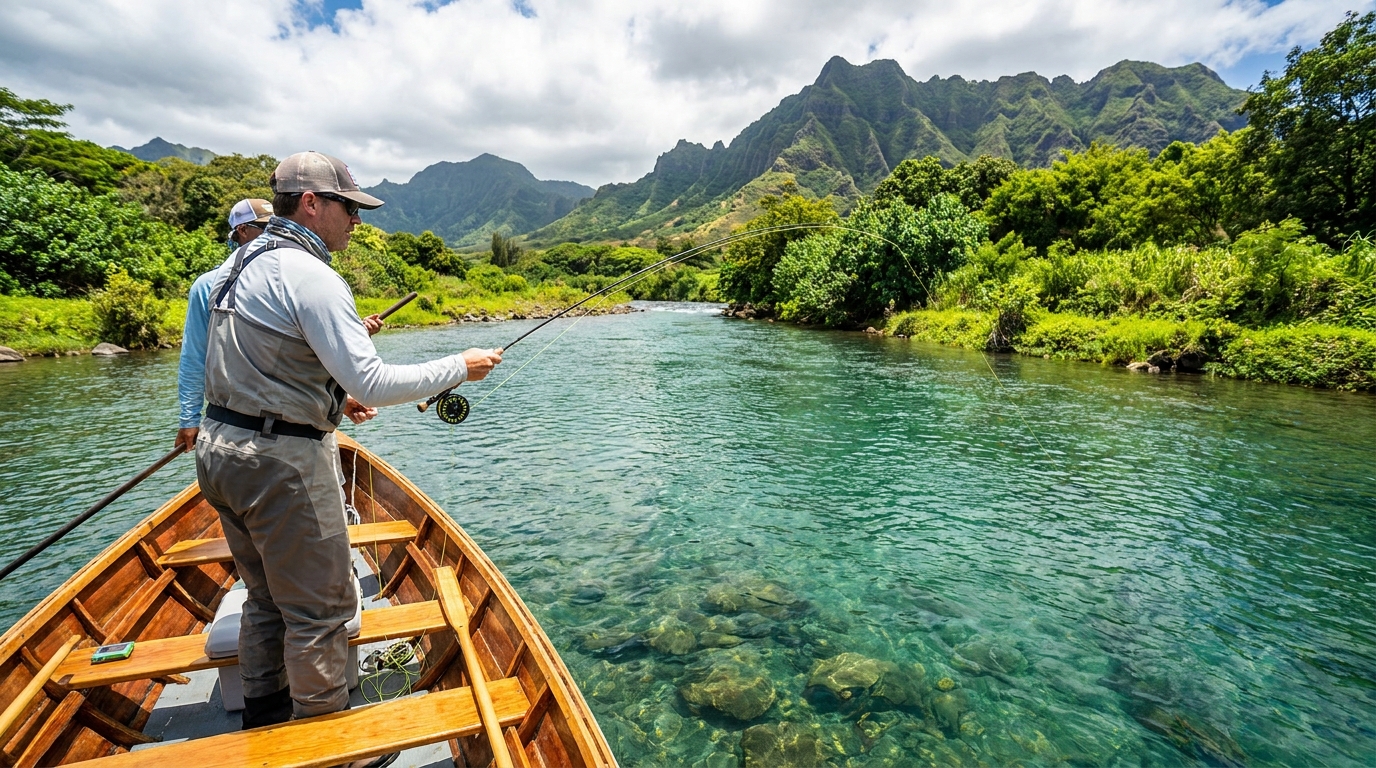
Maui, often celebrated for its volcanoes and beaches, presents a uniquely challenging yet ultimately rewarding frontier for the dedicated saltwater fly angler. This isn't your average flats destination — success here demands a shift in mindset, heavy tackle, and specialized tactics focused on adaptation and localized knowledge.
The Maui Reality Check: Limited Flats, Unlimited Fight
The fly fishing experience on Maui is defined by a critical geological constraint: the limited accessible flats. Unlike many famous bonefishing destinations known for vast, shallow hard-bottom expanses, Maui's 'Ō'io (Bonefish) are often targeted in deeper sand troughs, along reef edges, and in limited, publicly accessible shorelines. This environment dictates the use of heavier, rapidly sinking flies and precise casting techniques.
While Bonefish are the primary flats pursuit, the island's species diversity is compelling. Anglers can also encounter the explosively fighting Giant Trevally ('Ulua), various other Trevally species, and even pelagic fish like Tuna and Mahi-Mahi in offshore waters.
Target Species: Bonefish and Giant Trevally
The Hawaiian Bonefish Complex: Hawaii hosts two distinct species — the larger Albula glossodonta (Indo-Pacific round jaw) and the endemic, smaller A. virgata (sharp jaw). The larger species often justifies using heavier tackle and larger fly sizes, sometimes up to a 1/0 hook for eight-pound-plus fish. The smaller species may require more delicate presentation and conventional smaller bonefish hooks (size #4 to #6).
The Giant Trevally ('Ulua): The GT is arguably the most challenging nearshore game fish — pure muscle that demands the absolute heaviest tackle. GTs are notorious for charging out of the reef to grab a fly and instantly charging back in to cut the line on the rocks. Any weakness in your equipment will be exposed.
Know the Law: Regulations and Respect
While no saltwater fishing license is required, strict regulations govern where and how marine life can be taken. Anglers must be vigilant regarding boundaries near the 'Āhihi-Kīna'u Natural Area Reserve in South Maui, which strictly prohibits all forms of fishing. Adhere to a strong catch-and-release ethic, especially for bonefish and trevally.
Where to Cast: Locational Intelligence
South Maui Flats (Bonefish): The "mudflats" between Kihei and Maalaea Harbor, specifically near the Kealia Wetland/Wildlife Sanctuary, offer comparatively easy access. Productive areas are also found near Wailea and Makena.
West Maui: Flats spots between Lahaina and Kaanapali. Casting near Black Rock at Kaanapali Beach can attract a variety of reef fish and cruising trevally.
Optimal Timing: Best visibility is typically between 10:00 AM and 2:00 PM when the sun is high. To avoid strong trade winds and beach crowds, target 8:30 AM to 1:00 PM. Fish Makena Landing early in the morning before snorkelers arrive.
Essential Gear Matrix
For Bonefish: 8-weight fly rod, large arbor reel with 175–200 yards of backing, 8-wt floating line. A 9-foot tapered leader, preferably 0X fluorocarbon.
For Giant Trevally: 9- to 10-weight rod, extremely durable reel. Tippet strength ranging from 40# to 100# (high-test mono or fluorocarbon).
Specialized Tactics
Bonefish Tactics: Focus on the incoming tide when bonefish actively feed. Move slowly and deliberately — minimize false casting, as line shadow and motion will spook the elusive 'Ō'io. Cast approximately one rod length (9 feet) in front of the fish and slightly beyond its path. Always use a firm, horizontal strip-set — never lift the rod.
Trevally Tactics: Target GTs in channels, near reef structure, and along the shoreline. Casting distance is critical. Use an aggressive, high-speed retrieve that mimics fleeing or wounded prey. When the GT eats, hold tightly and immediately apply maximum pressure to keep it away from the structure.
Summary of Critical Mistakes to Avoid
- Minimize false casting — it tires the angler and spooks fish.
- Use heavy tackle — bonefish demand 200 yards of backing and GTs require heavy tippet.
- Use heavy flies — lightweight bead-chain flies will fail in Maui's deeper flats.
- Master the strip-set — non-negotiable for securing the hook.
- Be stealthy — move slowly and deliberately while wading.
For first-time visitors, engaging a professional, licensed guide is highly recommended to save time, increase efficiency, and ensure compliance with local regulations and location boundaries.